|
Spatially Enhanced Tag Clouds
|
|
by Ian Saunder
|
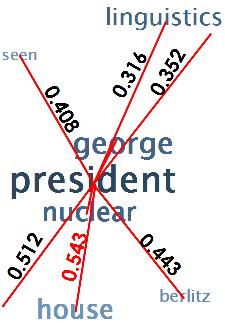
A tag, as it relates to information technology, is generally a keyword that is associated with or assigned to a resource. Tags are often grouped together into a collectively shared area called a tag cloud. This is static in nature and shows each tag’s frequency by changing its appearance. By extending this system to emphasize the importance of spatial relationships amongst these tags, it is envisioned that associations between these tags can be measured and converted into a useful form. A system with the abovementioned qualities was implemented, and required its users to read a piece of text which they would then tag with a term that appeared within it. Users were then able to reposition these tags so that related tags were in close proximity to one another while at the same time being distant to ones that they had little relation to.
|
|
Research Objectives
|
The primary goal of the project was to investigate novel
mechanisms that are able to create data that is present and current. While the managed
hierarchical data models that are mentioned above serve several notable purposes, they
are inherently static in nature, and are limited in their ability to adapt to changing
perceptions. This shortcoming ensures that numerous relationships that they
communicate are often dated.
In an attempt to investigate techniques that are able to partially remedy this hindrance,
manual means of textual categorization are extended to produce a system
whose output will express a current interpretation of the relationships between the terms
of a limited vocabulary. Positive results will be epitomized by semantic data that is both
current and useful to individuals and organizations that rely on data categorization and
retrieval.
|
|
Background
|
Tag clouds are visually weighted renditions
of collections of terms that can be used to
represent and interface to the concepts that
are contained within collections of
information [12]. They are generally
envisioned as a collection of user-defined
tags that can differ in visual appearance,
depending on their prominence. Their
somewhat graphical nature and ease of use
have contributed to their popularity as a
method to support and facilitate the
navigation and retrieval of tagged data.
|
|
Design and Implementation
|
A substantial effort was put into finding a suitable platform from which the tagging system could be run. After much thought, we decided
to embed the tag cloud within a Facebook Application, due to the ease of exposure and familiarity with the Facebook API.
As such, the tag cloud system was embedded with the application, allowing users to be able to interact direct with it form within Facebook itself.
Source data from which tags cloud be chosen was taken from UnNews. UnNews is a humorous and often completely inaccurate news source that forms part of
Uncyclopedia, the content-free encyclopedia. The latter exists as a parody to Wikipedia,
and has seen dramatic increases in popularity over recent months. UnNews is freely
available under a Creative Commons license which allows for its use and modification,
making it ideally suited to the purposes of the application. The application content,
therefore, exists in the form of specific news stories taken from UnNews which are
humorous and not offensive.
|
|
Testing
|
The absence of a comparable system increased the difficulties faced when attempting to
formulate a suitable evaluation of the spatially-enhanced tagging system. As such, a large
part of the system assessment is based upon user feedback that relates both directly and
indirectly to the software based tagging tool.
- Regular User Evaluation
Regular users can be envisioned as those individuals that casually make
use of the Facebook application that communicates the ideas behind the extended tagging
metaphor.
In order to assess the significance of the data created through the applications use, a
questionnaire was compiled that related to three select tag clouds from the system.
From these three tag clouds, the most frequent word from each was paired
with every other word from that particular cloud. For example: if the most frequent tag
from a hypothetical tag cloud was cow and the other tags from that cloud were animal,
milk and farm, then (cow, animal), (cow, milk), and (cow, farm) would be the pairs that
are created.
- Expert User Evaluation
Five MSc students from the department
were asked to read all of the eleven articles from which the tag clouds were created.
They were asked to answer four questions relating to the
tag clouds themselves, with specific focus on the tag clouds internal tag structure.
|
|
Results
|
Although no hierarchical structures were able to be fashioned out of the data produced by
the extended tagging metaphor, accurate and presentable associations between the terms
of a close vocabulary were generated as a result of the systems use. Tests that probed a
sample population’s perceived associations between word pairs showed a strong
correlation to the results of the tagging system. These results support the notion that
When compared to the results of a test that probed the test subjects’ perceived
associations between select words, the output of the tagging system appeared to show a
strong correlation. This observation reinforced the notion that the spatial distances that
separate pairs of tags is able to be transformed into a probabilistic relationship between
the two bodies.
|